

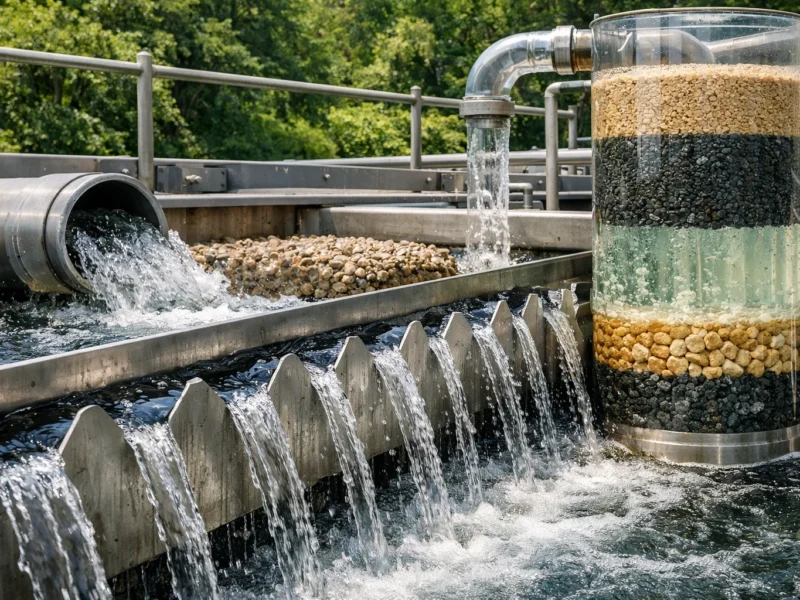
What is Water Treatment?
Water treatment removes harmful contaminants, suspended solids, microorganisms, and chemical pollutants from raw water sources through controlled physical, chemical, and biological processes. This multi-stage purification renders water safe for human consumption, industrial operations, and environmental discharge by systematically lowering turbidity, neutralizing pathogens, and balancing pH levels.
Untreated water may contain bacteria, heavy metals, organic materials, dissolved salts, and sediment that can pose health risks to humans and adversely impact industrial processes. Today’s treatment facilities are engineered to clean the water through several carefully controlled steps that progressively reduce the amount of impurities while still complying with the strict public health and environmental regulations.
Common Contaminants Removed During Water Treatment
The main contaminants that are removed in water treatment include the following:
- Lead
- Arsenic
- Mercury
- Bacteria
- Viruses
- Sediment
- Organic waste
- Chlorine byproducts
- Hardness-causing minerals
How Water Treatment Works
Water treatment is done by passing the raw water through a series of physical and chemical barriers, which slowly remove the contaminants. Surface water from the rivers, lakes, or underground sources is contaminated with suspended solids, microorganisms, dissolved minerals, and organic contaminants. The treatment process includes a series of steps, each of which removes a specific class of impurities.
This starts with screening and the removal of sediment to remove larger debris and suspended particles. Special chemicals are then added to break up the microscopic contaminants into floc, which is larger. These particles settle out in sedimentation prior to the water passing through filtration systems that remove even smaller particles.
The last line of defense is disinfection. Pathogens, including bacteria, viruses, and parasites, which are not filtered out, are neutralized by chlorine or ozone, or UV light. The use of other treatment techniques, like pH neutralization and activated carbon filtration, enhances taste, odor, and chemical stability.
Throughout the process, automated sensors continuously monitor turbidity, disinfectant residuals, and microbial activity. This real-time data ensures every batch meets strict regulatory standards before entering the municipal distribution network.
Stages of Water Treatment
Coagulation and Flocculation
When chemicals, like aluminum sulfate or ferric chloride, are added to raw water, coagulation occurs. These substances have a positive electrical charge that will neutralize particles in the water that have a negative charge. After destabilisation, the particles start to coalesce rather than being dispersed.
Slow mechanical mixing can be used to promote particle collisions after coagulation, creating flocculation. These small particles slowly aggregate into larger sticky groups of particles known as floc. The dirt, bacteria, algae, and organic matter are trapped by the floc and can be easily filtered away at later stages.
Floc formation chemistry is important as it is responsible for increasing the settling efficiency of the tiny particles to heavy particles. Proper pH neutralization is also crucial because coagulation performance is greatly dependent on water chemistry.
Sedimentation
The water goes into large sedimentation tanks after flocculation, and gravity separates the heavy floc from the cleaner water over it. When water velocity decreases in the basin, floc particles deposit on the bottom of the basin as sludge.
The settled sludge is constantly removed by mechanical scrapers and further treated. Sedimentation is very effective in reducing turbidity and the burden on downstream filtration systems. Treatment plants are more efficient and prolong filter life by removing suspended solids in an earlier stage of treatment.
Filtration
Smaller contaminants that are left behind after sedimentation are removed by filtration. The water is forced to flow through several beds of sand, gravel, anthracite coal, or activated carbon. The filter material is able to hold fine sediments, microorganisms, and organic particles.
Activated carbon filters are very effective at removing odors, chlorine compounds, and dissolved organic chemicals. Advanced membrane filtration systems can also be employed to remove “ultrafine” contaminants, which cannot be removed by conventional filters.
The filtration process helps to clear the water and decrease the amount of pathogens that reach the disinfection phase. Filters are kept clean and maintain a constant treatment performance due to regular backwashing.
Disinfection
Filtration removes microorganisms, but there may be some that resist filtration and can still cause harm, which can be eliminated by disinfection. Dichlorophenol is one of the most popular disinfectants because it is effective throughout water pipelines and storage systems.
In high-tech facilities, ultraviolet light and ozone treatment are also employed. UV systems will be effective at disrupting the microbial DNA and preventing the reproduction of microorganisms, whereas ozone is a very powerful oxidizing agent that will break down the contaminants and enhance the taste.
This step is crucial to neutralize the pathogens and to stop water-borne diseases. Disinfectant is carefully monitored in treatment plants to be as effective as possible to minimize chemical byproducts.
Distribution
After treatment, the clean water moves into a distribution system consisting of storage tanks, pumping stations, and underground pipes. To ensure a steady pressure in the system and supply during peak demand, water towers are installed.
The distribution system is monitored for leaks, contamination threats, and pressure changes on a continuous basis. Strategies are also in place to alleviate corrosion of pipes, which can lead to the release of metals into the water supply.
Water Treatment Plant Working Process
A modern water treatment plant is a well designed plant, processing millions of liters of water per day. The process begins at intake structures, which are placed in a lake, river, or reservoir and feature large intake screens to prevent branches, debris, and floating trash from entering the plant.
Raw water is pumped into large coagulation and flocculation basins where the chemicals are fed into the water by automatic chemical dosing systems. The controlled turbulence of the rotating mixers enables the formation of floc particles without dispersion. The water then goes to sedimentation tanks, where the sludge will settle and will be mechanically removed.
These massive concrete basins and steel pipelines operate under precise hydraulic gradients, allowing gravity and controlled flow rates to optimize separation efficiency without manual intervention.
Filters are designed to filter down to very fine resolutions that are carefully regulated to ensure a high percentage of contaminant removal. Turbidity, pH, chlorine concentration and microbial activity are monitored in real time via automated sensors. Operators can easily make any necessary changes in treatment parameters if water quality changes unexpectedly.
Back-up power, control rooms, emergency valves, and redundant pumps provide uninterrupted operation at a large scale. These are integrated mechanical, chemical and automation facilities that ensure safe water supplies to whole communities, on a continuous basis.
Reverse Osmosis Water Treatment
Reverse osmosis is an advanced purification process that removes dissolved contaminants at the molecular level, using a special membrane. Reverse osmosis is different than regular carbon filtration because it is used to remove very small contaminants, such as dissolved salts, heavy metals, and micro pollutants that regular carbon can not.
In the process, water is pushed through the semi-permeable membrane whilst the contaminant is left behind. The membrane has very small pores, preventing ions, bacteria, and dissolved solids from passing through that standard filters cannot.
RO systems are used in all sizes of residential purification systems, in industrial processes, and in large desalination plants that turn seawater into potable water. Since RO systems deliver water at a very high level of purity, they are used in conjunction with pre-treatment such as a sediment filter and an activated carbon filter to ensure that the membrane is not clogged.
Reverse osmosis is more efficient than regular filtration, but more energy-intensive and maintenance-intensive.
Industrial Water Treatment System
The water treatment system is an essential component in industrial facilities for process water throughout the manufacturing, cooling, cleaning, and production operations. The poor water quality will cause scaling, corrosion, biological fouling, and equipment breakdown, leading to high maintenance expenses and loss of efficiency.
Scale deposits in the boiler, cooling tower, and heat exchanger decrease heat transfer efficiency and add to energy costs due to the mineral content of the water. Water with corrosive properties can also cause damage to metal structures and to the manufacturing process.
Many industrial systems use softening, chemical dosing, reverse osmosis, filtration and pH neutralization to control water chemistry with great accuracy. Industries like pharmaceuticals, textiles, food processing, and power generation demand very stringent water quality specifications to ensure product uniformity and safety in operation.
The characteristics of individual facilities, the types of contaminants found in each, and the regulations applicable to them all make it essential to consult water treatment experts for the design of effective industrial systems.
Wastewater Treatment Process
Wastewater treatment is the process of purifying wastewater effluents, such as sewage and industrial effluents, before discharging treated wastewater into rivers, lakes, or the environment. Wastewater systems aim to lessen pollution and safeguard ecosystems compared to drinking water systems, which are focused on water that is intended to be consumed.
It begins with large debris and solid waste being filtered out with screening systems. In primary treatment, the heavier solids are separated from the liquid waste in sedimentation tanks. Secondary treatment uses biological processes to remove dissolved organic pollutants through the addition of microorganisms.
Further tertiary treatment can eliminate N and P, which are nutrients that can cause algae growth and harm to the environment. The chlorine or ultraviolet disinfection process kills the last of the pathogens prior to discharge.
Conclusion
Water treatment is crucial in safeguarding the health of the public, ensuring the preservation of infrastructure, and promoting environmental sustainability. Treatment systems can take out the turbidity, pathogens, dissolved chemicals, and harmful contaminants from raw water sources through coagulation, filtration, disinfection, and reverse osmosis.
Today’s treatment facilities integrate engineering, chemistry, and automation to provide safe, consistent water for residential, commercial, and industrial purposes. Also, wastewater treatment systems help safeguard ecosystems by minimising pollution before it enters the environment.
From municipal water supplies to industrial processes to advanced desalination methods, partnering with water treatment experts guarantees accurate testing, system design, and reliability.
Recent Comments